

3D Printed Concrete Chapels
3D printed concrete chapels, religious and wedding structures in any design.
Discuss your order Message on Viber
| Design | bespoke |
| Material | 3D printed concrete |
| Price | per project |
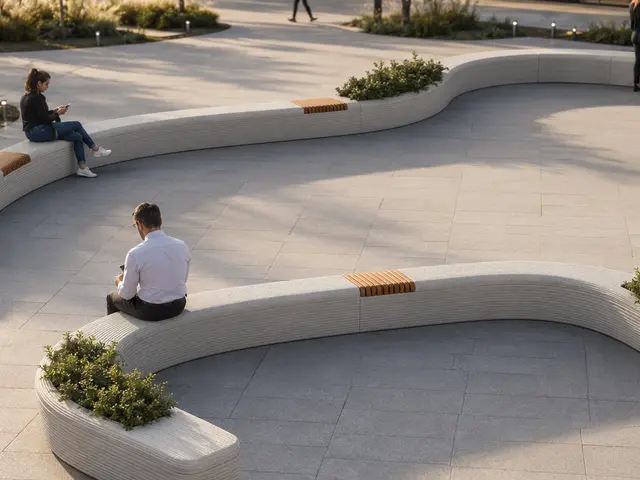
A chapel is a small but deeply symbolic building, and its form should be memorable. 3D printing gives the architect freedom: arches, domes, flowing walls and reliefs are built without complex hand-made formwork and remain strong for decades.
What we build
- chapels at churches, cemeteries and memorials
- wedding chapels and arches for hotels and event venues
- small sacred structures on private estates
How we work
We develop the concept together with the client and architect, prepare visualisations and drawings, print the elements in our workshop and install them on site.

Frequently asked questions
What concrete do you print with?
Heavyweight concrete made with clean cubical crushed stone up to 10 mm, with no dusty screenings. The sand is quarry sand; clay and metal particles are removed by a powerful magnet above the conveyor. For thin-walled products we use only fresh M500 cement, which does not cause efflorescence, plus a plasticiser. Because the layers are compacted by extrusion rather than vibration, the mix contains more cement than ordinary concrete.
Why is every element 20 cm high?
Our production is standardised around this height. Almost any structure can be broken down into blocks in multiples of 20 cm with monolithic joints. This height gives precise layer geometry without the "elephant foot" effect and a manageable block weight: 40 kg on average, about 60 kg at most, so two people can lift it.
Will 3D printed concrete crack?
Every structure includes monolithic joints that carry the dead load, wind and snow, as well as expansion joints, composite reinforcement and coarse aggregate that acts as micro-reinforcement. As a result, the products withstand transport over 1,500+ km and all service loads. The design service life is over 100 years.
How are the products reinforced?
Each printed contour is reinforced twice along its height with certified composite rebar from a trusted manufacturer (Arvit). It does not lose its properties over time.
How do you ensure the layers bond into a solid whole?
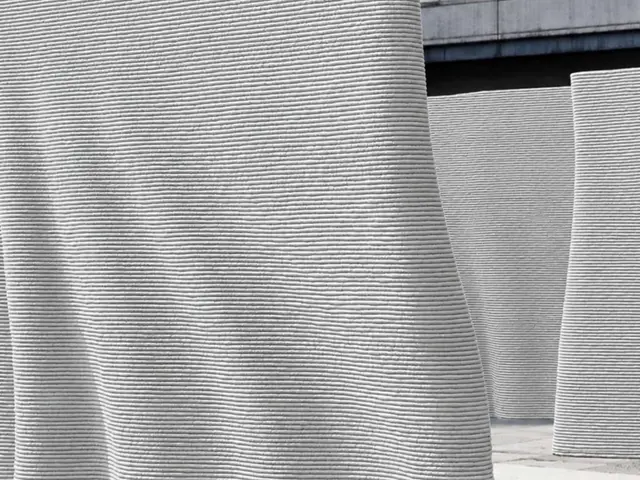
Layer-to-layer adhesion is the key to 3D printing. We control the layer deposition time, concrete workability, air humidity and temperature, and the products are cured in a steam chamber.
Does a fence need a strip foundation?
No. Most fences are installed on point pier foundations with vertical rebar starters (usually 2 bars of 12 mm diameter). The entire load of a section is transferred to the monolithic joints, so a strip foundation is unnecessary, and a pier foundation cuts the amount of reinforcement and concrete work by about 5 times. Houses, of course, need a strip foundation or an insulated slab foundation.
I already have a strip foundation with posts. Will it work?
Send us the measurements and post spacing, and we will design a matching structure. If they don't match, the old posts or rebar are cut off and new anchors are set with chemical anchoring, or rebar is driven into the existing foundation.
My dog digs under the fence. What can I do?
Rather than building a strip foundation, it is more cost-effective to bury the bottom 1–2 rows of the fence. W6 concrete performs well in the ground.
Let's discuss your project
Leave your phone number and we'll call you back within one business day. Or message us on Viber.
Or call us:
+38 067 401 00 94